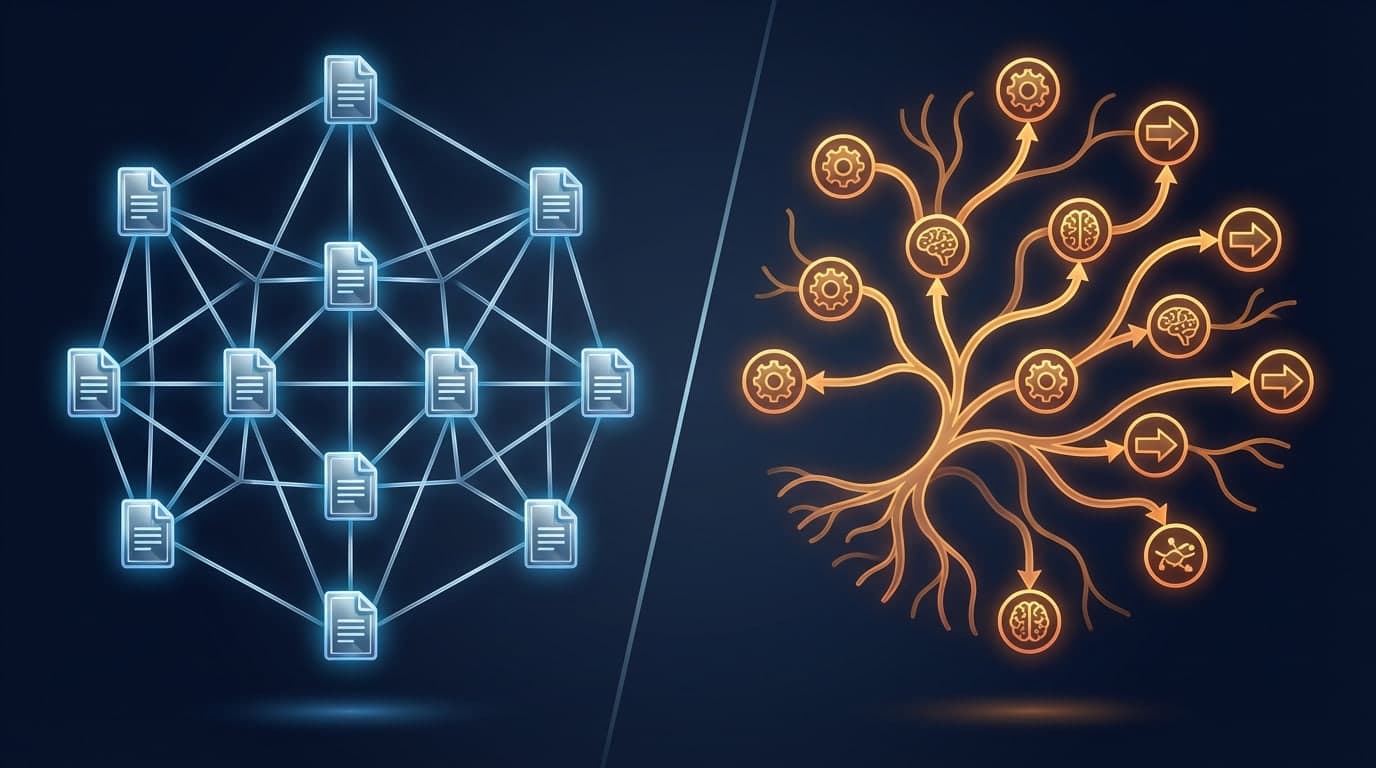
Context Graph vs Graph RAG: They Sound Alike, But They're Not
A Confusing Name
I recently came across an article from Foundation Capital titled "Context Graphs: AI's Trillion-Dollar Opportunity." A trillion-dollar opportunity? That got my attention.
But as I read through it, I got a bit confused. Context Graph? Isn't that just Graph RAG? Both involve graphs, both aim to give AI better context. What's the difference?
After thinking about it more carefully, I realized these two concepts, despite their similar names, solve fundamentally different problems. Understanding this distinction actually reveals something important about where AI agents are headed.
Let me walk you through it.
Starting with Graph RAG
Graph RAG isn't new. It's an evolution of RAG (Retrieval-Augmented Generation).
The logic behind traditional RAG is simple: when a user asks a question, you find relevant document chunks from your knowledge base, feed them to the language model, and let it answer based on that context. The problem is that documents get chopped into isolated pieces, and the relationships between them get lost.
Say you ask "What's our refund policy for enterprise customers?" Traditional RAG might only retrieve the refund policy section. But in reality, enterprise customers have special terms, those terms link to SLAs, and SLAs affect the refund process. Traditional RAG can't see these connections.
Graph RAG's approach: organize knowledge as a graph first. People, products, and concepts mentioned in documents become nodes. Relationships between them become edges. When you query, you don't just find similar text. You traverse relationships and bring back connected context.
This is genuinely useful. Better retrieval, more complete answers, fewer hallucinations.
But at its core, Graph RAG is still doing one thing: helping you find knowledge that already exists.
What Context Graph Is About
The Context Graph that Foundation Capital describes solves a different problem entirely.
Here's their definition:
"We call the accumulated structure formed by those traces a context graph: not 'the model's chain-of-thought,' but a living record of decision traces stitched across entities and time so precedent becomes searchable."
Let me translate: Context Graph isn't for finding information. It's for remembering why we made certain decisions.
This sounds abstract. Let me give you an example.
Imagine you're a sales rep at a SaaS company. A big customer is up for renewal. Policy says you can only offer 10% off, but the customer threatens to leave. You escalate to your VP, who says: "Fine, give them 15%. We did the same thing for ACME last quarter."
What gets recorded in the CRM? "Discount: 15%."
That's it.
What about all the crucial context? Why did this customer get an above-policy discount? What was the VP's reasoning? What was the ACME situation? None of that gets recorded. It lives in Slack threads, in that phone call, in the VP's head.
Three months later, you leave the company. A new sales rep faces a similar situation and has no idea this precedent exists. An AI agent would be even more clueless. Where would it even look? This information was never turned into "data."
This is what Context Graph captures: the decision itself, plus all the context around it. Who approved it, why they approved it, what precedent they referenced, what the state of various systems was at that moment.
This isn't a retrieval problem. It's a recording problem.
Two Graphs, Two Mindsets
The distinction should be clear now:
Graph RAG asks: What do we know?
Context Graph asks: What did we decide, and why?
Graph RAG extracts knowledge from existing documents and organizes it into a graph for better retrieval. Its data source is static: your knowledge base, documents, manuals. The graph is built offline and updated periodically.
Context Graph captures decisions from actual business execution and records them as precedent. Its data source is dynamic: every time someone (or an AI) makes a decision, new data is created. The graph grows in real-time as the business operates.
One helps you find answers.
One helps you remember why.
One Scenario, Two Kinds of Help
Let me illustrate with the same scenario.
Same customer renewal case. An AI agent needs to handle it.
What can Graph RAG help with?
The agent asks: "What are the standard renewal terms for enterprise customers?"
Graph RAG traverses the knowledge graph: Renewal Policy → applies to Enterprise Customers → standard discount cap 10% → but annual contracts can get an extra 5%...
The agent gets the rules. It knows what policy says it should do.
What can Context Graph help with?
The agent asks: "Has this customer had a similar situation before? How did we handle it?"
Context Graph returns: In Q2 2024, this customer also threatened to leave during renewal. The VP approved a 15% discount. Decision rationale: Customer ARR $200K, 3 unresolved technical issues, competitor actively reaching out. VP's judgment: "High-value customer + churn risk, worth extra investment to maintain relationship."
The agent gets precedent. It knows how this situation was handled before and why that was the right call.
Graph RAG provides rules. Context Graph provides case law.
Rules tell you what you should do. Case law tells you what was actually done, and why it was justified.
Why This Distinction Matters
Foundation Capital's thesis is that Context Graph could be the next trillion-dollar opportunity because it becomes a new kind of "system of record."
Traditional systems of record (Salesforce for customers, Workday for employees, SAP for transactions) all record "what happened."
Context Graph records "why it was allowed to happen."
This "why" has always been scattered across various places, never systematically captured. But in an era where AI agents are becoming increasingly autonomous, this "why" becomes crucial:
- Compliance teams need to audit agent decisions
- Agents need to learn from past exceptions
- New employees need to inherit the judgment of those who left
- Organizations need decision consistency
Graph RAG can't help here because this information was never written into documents. You can't retrieve what doesn't exist.
Context Graph can help because it captures this information directly at the moment decisions are made.
Why Incumbents Can't Do This
Foundation Capital makes another interesting point: existing enterprise software giants will struggle to build Context Graph.
Why? Because they're not in the "execution path."
Salesforce knows customer information, but it doesn't know how a deal was actually negotiated. Snowflake can store historical data, but by the time data reaches it, the decision context is already lost. ETL moves results, not process.
To capture the complete context of a decision, you have to be where the decision happens. You have to be the system executing the workflow, not the system receiving data after the fact.
This is why Foundation Capital believes startups building agent orchestration layers have a structural advantage. They're naturally in the execution path, seeing the full picture of decisions: what data was pulled from which systems, what policy was evaluated, what exception process was followed, who approved it, what state was written.
Record all of this, and you have a Context Graph.
They Can Coexist
After all this about differences, the two aren't mutually exclusive. They solve different problems and can work together.
Graph RAG is the knowledge layer: helping agents find relevant rules, policies, background information.
Context Graph is the precedent layer: helping agents find similar historical decisions and understand how the organization actually operates.
A complete AI agent system probably needs both. Use Graph RAG to understand "what the rules are," use Context Graph to understand "how the rules have been applied." One provides knowledge, the other provides judgment.
Implications for Builders
If you're building AI agent products, this distinction might be useful:
If your users struggle with "can't find the information," Graph RAG is the answer. There are already plenty of tools in this space: LlamaIndex, LangChain, Neo4j. You're improving retrieval.
If your users struggle with "don't know why decisions were made this way," Context Graph is the opportunity. You need to figure out how to get into the execution path and capture the full context of decisions. This is a newer field, and potentially a bigger opportunity.
Of course, if you're building a complete agent platform, you probably need both.
In the End
Graph RAG and Context Graph sound similar but solve completely different problems.
One makes AI better at finding things.
One makes AI better at remembering things.
Both matter. But if Foundation Capital's thesis is right, the latter might be the next big platform opportunity. Because finding things? Many people are working on that. Remembering "why"? Almost no one is.
And in a world where AI agents are becoming increasingly autonomous, remembering "why" might matter more than finding "what."
Published: December 27, 2025
Topics: AI Agents, Knowledge Graphs, Enterprise AI, RAG, Systems of Record
References:
- Microsoft Research: "From Local to Global: A Graph RAG Approach to Query-Focused Summarization" (2024)
- Foundation Capital: "Context Graphs: AI's Trillion-Dollar Opportunity" (December 2025)
New ideas, straight to your inbox.
AI, engineering, and experiments. One or two useful emails a month.
No spam. Unsubscribe anytime.