
Building an Enterprise Agent Harness from Scratch8/10: Should You Add More Agents When One Is Not Enough?
In the previous chapter, we learned to test one agent against the same set of questions. Now bring that method back to procurement: compare three vendors. Price research needs quotes, taxes, and payment terms. Compliance review needs data-residency information, security evidence, and contract clauses. The two branches use different materials and can work at the same time. Data residency means the country or region where customer data is stored; it can determine whether a vendor meets the company's purchasing requirements.
Parallel work does not automatically require more agents. One main agent can load separate price and compliance Skills—specialist procedure instructions—as needed. It can call the quote and contract-lookup tools in the same round and keep their results in one context. Each tool still checks data scope, action permissions, and approval conditions in code.
A single loop means that the same agent keeps reading results, choosing the next step, and calling tools. I start there, then separate work that actually needs its own context, independent verification, or parallel exploration. Copying the same muddled assignment to several agents and letting them discuss it freely often produces a meeting that nobody knows how to end.
First Show That the Work Is Worth Splitting
I first run one agent on the same set of procurement tasks and record completion rate, latency, cost, and blocked permission violations. Then I separate price research and compliance review and compare them on those tasks. The finish line remains a procurement recommendation supported by evidence. Two impressive subtask reports that fail to answer the overall question do not count as a successful split.
A split needs a concrete benefit: the branches need separate contexts and can run safely in parallel; the single loop already shows measurable context crowding or tool-selection problems; one branch must verify results independently of the main process; or the other side is already a separate system with its own identity and runtime lifecycle. Different team ownership or tool permissions alone can still be handled with Skills and permission checks inside each tool.
Keep the single agent's scorecard. Judge a split on the same tasks, rather than by the number of agents involved.
October 2026 Guidance: Fold Unnecessary Agents Back In
In her October 22, 2026 article, Anthropic's Diane Sarkis describes enterprises creating one subagent per team, mirroring the organization chart. Details are lost during handoffs, every extra call adds latency, and strong local scores can hide the absence of anyone responsible for the whole task.
Her alternative keeps planning and execution in a shared main-agent context. Specialist procedures, rules, and judgment go into Skills; live-data access, actions, and structured results go into tools. The agent sees short descriptions first and loads full instructions or tool definitions when needed. It can call tools in parallel, revise its own plan, and use price findings in a compliance decision without compressing them into a handoff summary first.
Subagents still have a role in independent parallel work, isolated context, verification, and modular permissions. For procurement, I build an end-to-end evaluation, fold in one subagent at a time, and compare quality, cost, and latency. I inspect which specific cases regress and repeat each test before deciding what to merge or retain. Tool and policy code continue to enforce authorization, approval, and data scope.
Use Two Work Orders Instead of “Discuss It Among Yourselves”
Now I will work through a split worth testing. Price research and compliance review each receive their own context, containing only that branch's materials and working records. They return conclusions with sources. Compliance runs in a separate system. I have the agent responsible for the overall task write two work orders. This role, which assigns work, follows up, and combines results, is the orchestrator.
The price work order names the three vendors, allowed quote and tax sources, output format, budget, and deadline. The compliance work order supplies only contract and security materials, requires official citations, and prohibits sending messages or changing records. Both identify their parent task, permitted actions, completion criteria, and where to send the report.
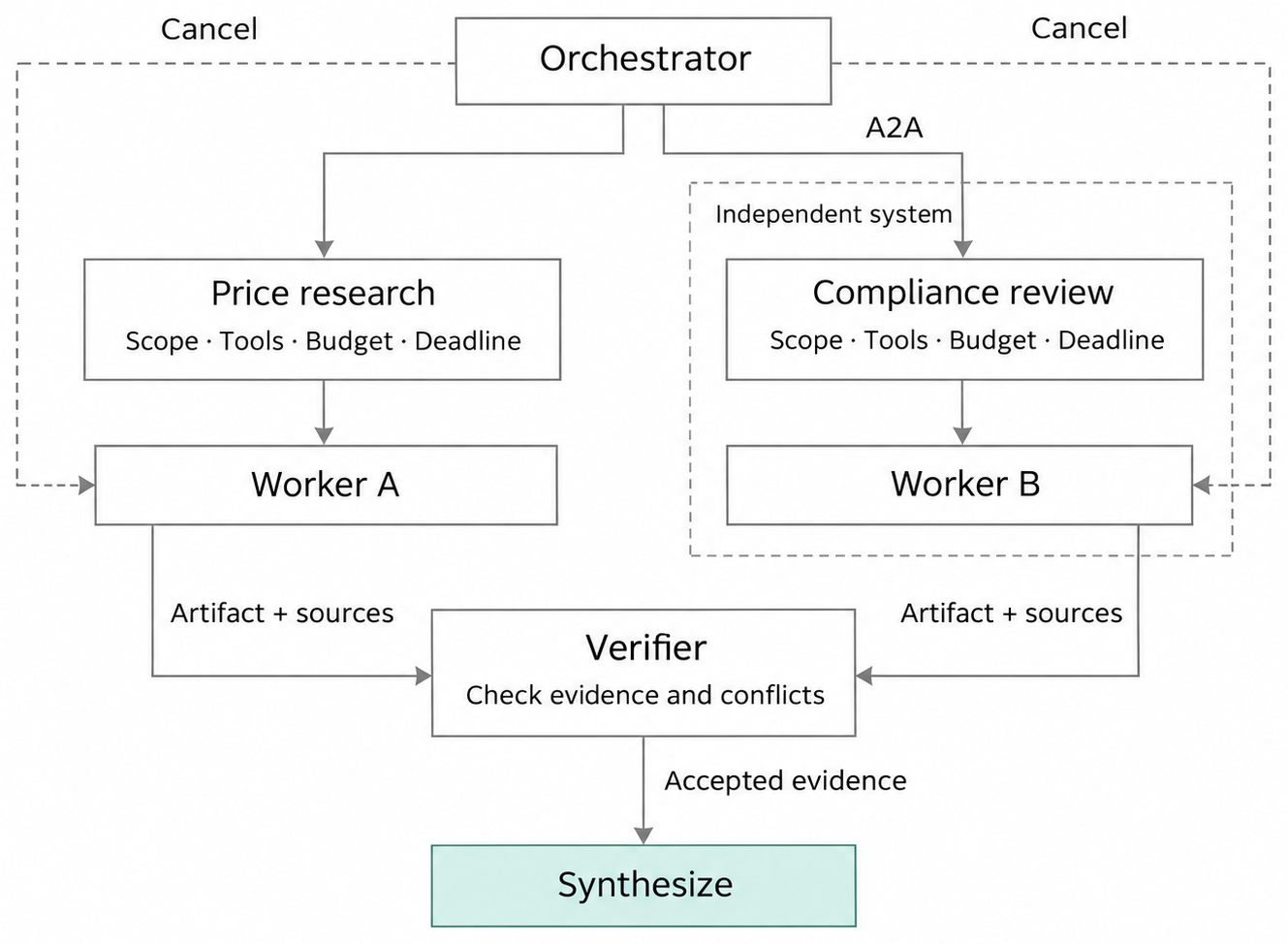
The diagram's two branches are Price research and Compliance review. Each agent receives its own scope, tools, budget, and deadline. Here, compliance is performed by a separate system with its own identity and runtime lifecycle, so its work order travels through A2A. If another team simply maintains a compliance Skill, the main agent can load it when needed without creating another agent.
Returned reports first pass through a verifier. Are the price calculations correct? Do the contract sources support the conclusions? Do the reports conflict? Only after those checks does the main agent combine the recommendation. The cancellation line reaches both branches: if the user cancels the purchase, both workers must stop.
For a fuller treatment of suitable tasks, prompt boundaries, context, parallelism, and recovery, see my earlier article, Building Effective Multi-Agent Systems: Lessons from Practice. Here, we will keep following responsibility in the procurement task: someone must still collect and verify the evidence after the work has been delegated.
Delegation contract: The structured boundaries given to a worker agent, including inputs, deliverables, permissions, budget, deadline, and acceptance criteria.
Who Is Responsible for Bringing the Work Back Together?
After dispatch, the orchestrator records which work orders were sent, which results have returned, their deadlines, and their cancellation state.
If the price report arrives first, the overall task is only partially complete and waits for compliance. If compliance times out, the owner decides whether to cancel remaining work, adjust the assignment, or hand it to a person. If the reports disagree, the verifier returns to the original contracts and quotes. Agreement between agents does not establish evidence.
The task-splitting program first checks whether each work order defines its inputs, scope, and deliverable. If a work order is invalid, the system can return to a single agent within the original authorization. If a review must remain independent, it pauses while that arrangement is corrected. Overlapping assignments that make different agents repeat the same work are replanned. The total budget is allocated to workers, and every call links back to the parent task. This makes the cost of the entire procurement study visible, including repeated model calls inside a subtask.
As the worker pool grows, a capability directory helps select a suitable agent. It records what each agent can do and how to contact it. Work crossing into another team carries identity and delegation checks. Cancellation sends stop instructions and credential revocation to every subtask. These responsibilities stay with the owner of the overall task.
Four Collaboration Methods, with Different Handoffs
First ask, “Who remains responsible after the work is handed over?” If I ask a price agent to research and continue after its report returns, that is a subagent call. If I transfer a customer to a refund agent that takes over the conversation, that is a handoff.
Then ask, “Where is the other side?” A work order sent to another team's independently deployed compliance agent can use A2A. A database query or email-tool call can use MCP. The former exchanges tasks and deliverables; the latter provides interfaces to tools and resources.
Within one application, the OpenAI Agents SDK can perform a handoff or expose an agent as a tool. LangGraph, Microsoft Agent Framework, and Google ADK help applications preserve state across steps. Across independent systems, A2A handles discovery, task delivery, and returned reports. “Discovery” means finding an agent that can accept the work and its access address. MCP connects database, search, or email tools.
Handoff: An agent transfers subsequent control and responsibility for user interaction to another agent.
Progress in 2026: A Stable Protocol for Cross-Agent Work Orders
The A2A Protocol defines how independent agent systems describe themselves, accept tasks, and return results. The compliance system publishes an Agent Card describing what it can review. The procurement agent submits a task and receives a report as an artifact, or deliverable. The systems exchange that information through the protocol while maintaining their own internal prompts and execution state.
A2A v1.0 was released on March 12, 2026, establishing its first stable production-ready protocol line. It supports different communication methods, version negotiation, multiple customer organizations, and signed Agent Cards; version 1.0.1 followed in May. For a compliance work order, these capabilities help the systems establish how they will communicate, which organization they represent, and who issued the capability card before delivering the task.
The protocol handles discovery and exchange. The procurement team still decides who may read the contract, what constitutes an acceptable review, and who owns a timeout. A signed Agent Card helps check the card's integrity and publisher. Policy still determines whether the current user may delegate, and the verifier still accepts or rejects the deliverable.
Anthropic's multi-agent systems research published on August 13, 2026 describes agents competing for shared resources, reinforcing incorrect conclusions, trusting malicious collaborators, and facing privacy limits on collaboration. Once agents can communicate, reliable division of work, constraints, and acceptance become the difficult part.
Anthropic's research system also offers a useful application. A lead agent decomposes a research question, assigns parallel exploration to specialist subagents, and combines their evidence. In its internal research evaluation under a specific configuration, Anthropic reported a 90.2% improvement over a single agent, alongside token use of roughly 15 times ordinary chat. The core benefit comes from exploring through independent contexts and returning compressed findings to the lead. That suits broad research such as vendor pricing. Procurement and payment workflows still need their own controlled comparisons.
A2A: An interoperability protocol for discovery, messages, tasks, and artifacts exchanged between independent agent systems.
Return to the Vendor Comparison
The price agent returns a standardized comparison table on time. The compliance agent returns data-residency evidence with official sources. The verifier checks the calculations and source validity, and the orchestrator combines the reports into a procurement recommendation.
If the compliance report lacks evidence, the system keeps the price results but does not mark the overall task complete. If the user cancels, both worker agents receive stop instructions. Parallelism and isolation provide the benefit; the original task contract and verifier retain the authority to declare completion.
The components in the first eight chapters now each have a reason to exist. Next, we will place them in one enterprise architecture and follow the refund from Chapter 1 from its entrance to its final evidence.
New ideas, straight to your inbox.
AI, engineering, and experiments. One or two useful emails a month.
No spam. Unsubscribe anytime.