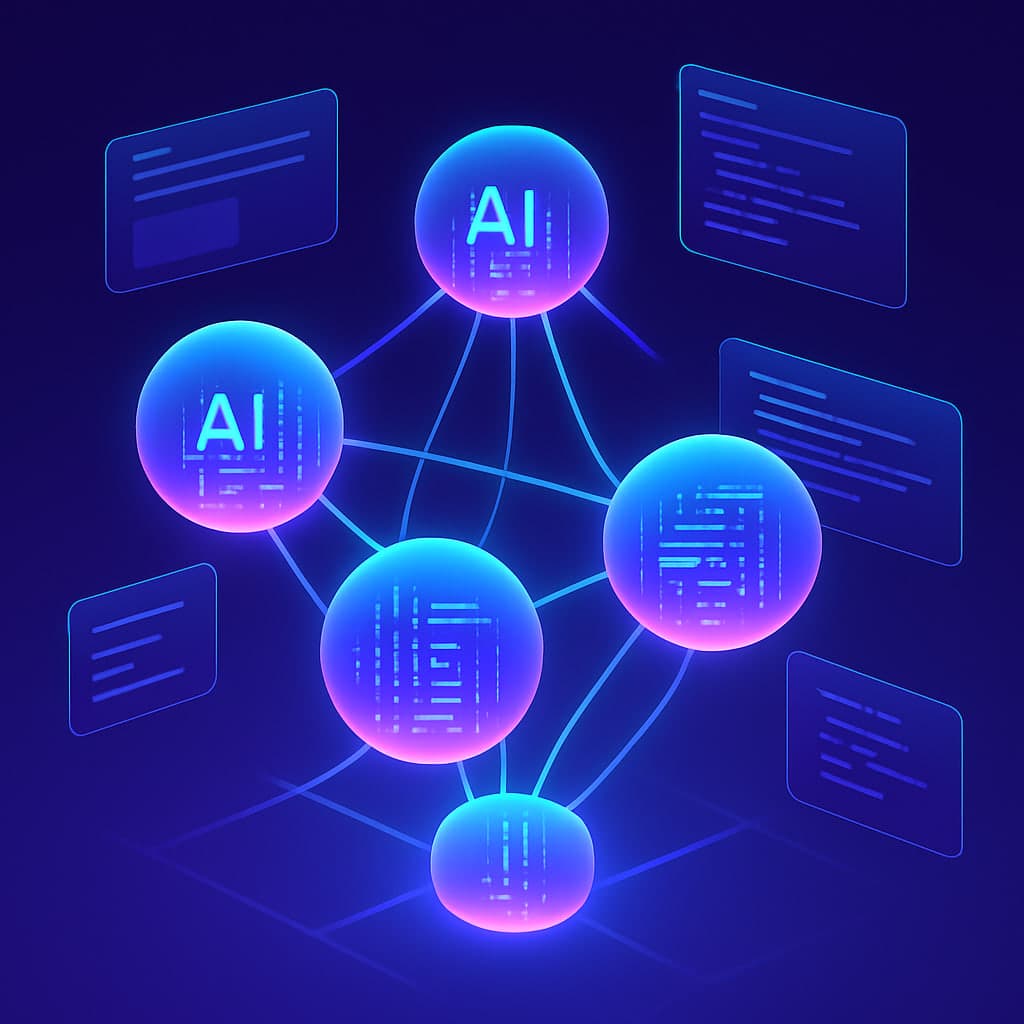
Building Effective Multi-Agent Systems: Lessons from Practice
The AI landscape has evolved rapidly from single, monolithic models to sophisticated multi-agent systems. But when should you actually use multiple agents? And more importantly, how do you build systems that work reliably in production? After working extensively with multi-agent architectures, I've learned that success comes down to understanding their fundamental advantages and limitations.
To answer these questions, we need to start with the most basic concept: why can multi-agent systems solve problems that single agents cannot? This answer will lay the foundation for all our subsequent design decisions.
Understanding the Core Advantage
The most common misconception about multi-agent systems is that they're simply about "dividing work." While that's partly true, the real power lies in something more fundamental: parallel context windows.
Think about how a single AI agent works. It processes information sequentially, with a limited context window. Imagine you're reading a book, but you can only keep about 20 pages in your head at once. As you read forward, you start forgetting earlier details. That's essentially what a single agent faces with linear reasoning and context limitations.
Now imagine you have a team of readers. Each person can hold their own 20 pages, and they can all read different sections simultaneously. Suddenly, you're not limited by a single context window but can explore multiple directions at once. This is the fundamental shift that multi-agent systems provide.
When one agent hits its context limit or needs to explore a different angle, another agent with a fresh context window can take over. This parallel processing of information isn't just faster, it's qualitatively different. It allows for exploration of multiple hypotheses simultaneously, comprehensive research across different domains, and the ability to maintain focus on specific subtasks without losing sight of the bigger picture.
However, understanding this core advantage leads to a more practical question: not all problems need parallel context windows. Forcing a multi-agent architecture where it doesn't fit will only increase system complexity and maintenance costs without providing benefits. This brings us to our next critical question: what types of tasks truly benefit from multi-agent systems?
Finding the Sweet Spot
Multi-agent systems aren't a silver bullet. They excel in specific scenarios and struggle in others. Understanding where they shine is crucial for effective architecture design.
To determine whether a task is suitable for a multi-agent architecture, the key is analyzing the task's dependencies and parallelization potential. Highly independent, parallelizable tasks are ideal choices, while tasks requiring tight coordination and frequent synchronization should be avoided.
Where Multi-Agent Systems Excel:
The ideal use cases share a common pattern: tasks that benefit from parallel exploration with minimal interdependencies. Research projects are a perfect example. When you need to investigate multiple directions simultaneously, perhaps exploring different technical approaches or gathering information from various sources, multi-agent systems shine. Each agent can dive deep into its domain without waiting for others to finish.
Isolated tasks with clear boundaries work beautifully. Think of a system where one agent handles data validation, another processes transformations, and a third generates reports. Each operates independently with well-defined inputs and outputs.
Complex tool chains also benefit immensely. When your workflow involves orchestrating multiple APIs, databases, and external services, having specialized agents for each integration point creates cleaner, more maintainable systems. One agent might be an expert at querying databases, another at calling REST APIs, and a third at processing file uploads.
Finally, when a task is simply too large for a single agent's context window, breaking it down into smaller, manageable pieces handled by different agents becomes not just beneficial but necessary.
Where They Struggle:
Interestingly, coding tasks often work better with a single, powerful agent. Programming requires maintaining a coherent mental model of the entire codebase, understanding how different pieces fit together, and making consistent decisions about architecture and style. Splitting this across multiple agents can lead to inconsistencies and integration headaches.
Similarly, any task requiring tight synchronization between steps becomes problematic. If step B critically depends on the exact output of step A, and step C needs both, you're essentially forcing sequential execution through a parallel system. The overhead of coordination often outweighs any benefits.
Having identified the right scenarios, we face our next challenge, which is more subtle: even when you've chosen an appropriate problem, the system will still fail if agents cannot collaborate effectively. The key to collaboration lies not in writing complex coordination code, but in how we design our prompts. Prompts are not just instructions; they define the entire collaboration framework.
Designing Collaboration Frameworks Through Prompts
Here's where many multi-agent implementations go wrong: they try to micromanage the agents' behavior by prescribing exact sequences: "You should do A, then B, then C." This approach fundamentally misunderstands how to leverage AI agents effectively.
The root of the problem is that this approach treats agents as traditional program flows rather than systems with reasoning capabilities. To make multi-agent systems truly work, we need to shift our mindset.
The Wrong Approach:
Procedural instructions like "First, search the database. Second, analyze the results. Third, format the output" treat agents like simple scripts. This removes their ability to reason, adapt, and handle edge cases. It's brittle and fails when reality doesn't match your predefined sequence.
The Right Approach:
Instead, think of your prompt as defining a collaboration framework. Specify the agent's role, goal, boundaries, and available resources, then let it figure out the best approach. For example:
"You are a research specialist focused on technical documentation. Your goal is to gather comprehensive information about API authentication patterns. You have access to web search, documentation databases, and code repositories. Focus on modern, production-ready approaches. Your research will be used by another agent to write implementation guidelines."
This framework approach respects the agent's intelligence while providing clear direction. The agent understands its purpose, knows what resources it can use, and has boundaries to work within.
Calibrating Effort:
One critical but often overlooked aspect is telling agents how much effort to invest. Without guidance, agents can be lazy on complex tasks or over-research simple questions.
For a simple question, you might specify: "This is a straightforward task. Use 1 agent and make 3-10 tool calls to gather the essential information."
For a moderate question: "This requires comprehensive analysis. Deploy 3-4 agents in parallel to explore different aspects."
For complex questions: "This is a deep research task. You may need 10+ agents working on different dimensions of the problem."
This effort calibration helps agents understand the scope and invest appropriate resources. It prevents both under-delivery and wasted computation.
However, good prompt design is only half the battle. When the system actually runs, we encounter a new challenge: how do we know what the system is doing? When multiple agents run simultaneously, each calling different tools and producing numerous intermediate results, traditional debugging methods are no longer sufficient. This is why observability becomes critical in multi-agent systems.
Building Observability for Debugging
Multi-agent systems introduce a new challenge: debugging becomes exponentially more complex when you have multiple agents working in parallel, each making its own decisions and tool calls.
In single-agent systems, you can follow the execution flow linearly. But in multi-agent systems, execution paths form tree or graph structures, with multiple branches progressing simultaneously and influencing each other. Without good observability, you simply cannot understand the system's behavior, let alone locate problems.
Effective observability requires answering five key questions at any point in execution:
What is being done? You need clear visibility into which agents are active, what tasks they're working on, and what actions they're taking. Simple logging isn't enough; you need structured traces that show the flow of work.
Why did that happen? Understanding the reasoning behind decisions is crucial. When an agent chooses to call a particular tool or pursue a specific direction, the reasoning should be captured. This helps distinguish between bugs and valid strategic choices.
What was the result? Every action should have clear outcomes. Did the tool call succeed? What data was returned? How did it affect the agent's subsequent decisions?
Which subagent failed? When something goes wrong (and it will), you need to quickly identify which agent encountered the problem and at what stage. This requires careful error propagation and attribution.
How did the lead agent make decisions? In hierarchical multi-agent systems, the orchestrating agent makes critical choices about which subagents to deploy and how to combine their results. These decision points need special attention in your observability strategy.
A practical implementation might involve structured logging with correlation IDs that track work across agents, decision trees that show why certain paths were chosen, and clear success/failure indicators for every operation.
Observability allows us to see what the system is doing, but there's an even more fundamental problem to solve: even when we can observe all behaviors, the system itself must be able to process information effectively. While multi-agent systems expand total context capacity, this doesn't make context management less important. On the contrary, as information flows between multiple agents, context management becomes even more critical.
Managing Context Effectively
Even with multiple agents, each having its own context window, you still face the fundamental challenge of information management. Context limits are real constraints that can break your system if ignored.
What makes it more complex is that in multi-agent systems, information needs to be managed not only within individual agents but also transferred between them. Ensuring that important information isn't lost while avoiding unnecessary redundancy requires carefully designed strategies.
The 200K Token Reality:
Modern models have impressive context windows, with some reaching 200K tokens or more. But that doesn't mean you should treat them as infinite. Context management remains critical for several reasons: larger contexts increase latency and cost, and more importantly, model performance often degrades with very large contexts as important information gets "lost in the middle."
Periodic Summarization:
One effective strategy is periodic summarization. Instead of maintaining the entire conversation history, have agents summarize key findings at regular intervals. These summaries become the new working context, dramatically reducing token usage while preserving essential information.
For example, after an agent makes 20 tool calls gathering information, it might create a structured summary: "Key findings: [3-5 main points]. Sources: [list]. Open questions: [remaining gaps]." This compressed representation maintains the essential insights while dropping the verbose intermediate steps.
External Memory:
For information that might be needed later but isn't currently relevant, use external memory systems. This could be a database, file system, or vector store. The key principle is "preview + pointer" rather than full insertion.
Instead of copying entire documents into context, store them externally and maintain lightweight pointers: "Research findings on authentication patterns stored in research_2025_11_20.json. Key topics: OAuth2, JWT, session management." Agents can retrieve full details if needed, but the context remains lean.
Smart Triggers:
Some systems implement smart reminders. For instance, Claude Code has an interesting pattern: if the TodoWrite tool hasn't been used for 10 rounds of conversation, the system injects a reminder. This prevents agents from losing track of task management without constantly cluttering the context.
With context properly managed, agents can truly leverage their reasoning capabilities. But having smart agents alone isn't enough. System performance largely depends on whether we can fully exploit the advantages of parallel computing. Multi-agent systems have inherent parallelism capabilities, but whether this capability translates into actual performance gains depends on how we implement parallelization at various levels of the system.
Maximizing Parallel Execution
Parallelism in multi-agent systems exists at multiple levels, and leveraging all of them is key to performance.
Many people, when designing multi-agent systems, only consider top-level agent parallelism and overlook optimization opportunities at deeper levels. In reality, parallelization can permeate every layer of the system, and optimization at each layer brings significant performance improvements.
Agent-Level Parallelism:
The most obvious level is having multiple agents work simultaneously. A lead agent might spawn three research agents, each investigating different aspects of a problem. They work independently and report back, with the lead synthesizing their findings.
Tool-Level Parallelism:
Within a single agent, you can call multiple tools in parallel when they don't depend on each other. If an agent needs to fetch data from three different APIs and the calls are independent, making them simultaneously rather than sequentially can save significant time.
Internal Tool Parallelism:
Even within individual tools, parallelism can exist. A database query tool might run multiple queries concurrently, or a web scraping tool might fetch multiple pages at once. This deep parallelism compounds the performance benefits.
The key is identifying dependencies accurately. Only tasks that truly depend on each other need to run sequentially. Everything else should execute in parallel.
However, parallel execution also introduces new challenges: when multiple tasks run simultaneously, failure in any one component can affect overall progress. In single-threaded systems, failure handling is relatively straightforward, but in multi-agent parallel systems, we need more sophisticated fault tolerance mechanisms. Without good checkpoint and recovery strategies, a small failure can render all the system's work futile.
Implementing Checkpoints and Fault Tolerance
In complex multi-agent systems, failures are inevitable. A tool might timeout, an API could be temporarily unavailable, or an agent might produce unexpected output. The difference between fragile and robust systems lies in how they handle these failures.
This isn't just a technical issue; it's also about cost and user experience. In production environments, restarting from scratch on every failure not only wastes computational resources but also extends user wait times. A well-designed fault tolerance mechanism can transform most failures into minor delays rather than complete do-overs.
One Failure Shouldn't Mean Starting Over:
The worst outcome is having a single tool failure after 30 minutes of work force you to restart from scratch. This is where checkpoints become critical.
Design your system to save progress at logical points. When an agent completes a major subtask, persist its results. When multiple agents finish their parallel work, checkpoint before moving to synthesis. This way, if something fails downstream, you can resume from the last good state.
Graceful Degradation:
Sometimes, perfect results aren't possible, but partial results are still valuable. If one of five research agents fails, can you proceed with four? If a tool call times out, can you use cached data? Building in this flexibility makes systems much more reliable in practice.
Retry Strategies:
Not all failures are permanent. Network blips, rate limits, and temporary service disruptions are common. Implement smart retry logic with exponential backoff. But also know when to give up and route around the problem rather than getting stuck in an infinite retry loop.
Bringing It All Together
We've explored the key aspects of multi-agent systems, from the fundamental advantage of context windows to specific implementation details. These seemingly independent technical points actually form a complete framework. Each part is important, but what matters more is understanding how they support each other to form a reliable system.
Looking back at the entire design process, we can see a clear logical thread: first understand the essential advantage of multi-agent systems, then identify suitable application scenarios, establish collaboration frameworks through carefully designed prompts, implement comprehensive observability to monitor running state, use scientific context management strategies to ensure information flow, maximize parallel execution efficiency at all levels, and finally ensure system reliability with checkpoints and fault tolerance mechanisms.
Building effective multi-agent systems requires thinking beyond "splitting up work." It's about:
- Understanding that parallel context windows are the fundamental advantage
- Choosing the right problems where parallelism and isolation provide real benefits
- Designing prompts as collaboration frameworks rather than rigid procedures
- Building comprehensive observability to understand and debug complex interactions
- Managing context carefully with summarization and external memory
- Leveraging parallelism at every level
- Implementing checkpoints and fault tolerance for reliability
These systems represent a new paradigm in how we build with AI. They're more complex than single-agent systems, but when applied to the right problems with careful design, they unlock capabilities that simply aren't possible otherwise.
The key is matching the architecture to the problem. Not every task needs multiple agents. But for those that do, understanding these principles makes the difference between a system that struggles in production and one that reliably delivers value.
New ideas, straight to your inbox.
AI, engineering, and experiments. One or two useful emails a month.
No spam. Unsubscribe anytime.