The AI's Will: Predicting the Future by Thinking Like an AI
What will AI change? Whom will AI replace? This is the primary question for understanding the future.
On Chinese New Year's Eve, I had dinner alone with an investor, and we talked about this. He'd invested in software, cryptocurrency, nuclear plants, data centers, farms. Caught every wave. Yet he couldn't see what changes AI would bring. As a CTO of an AI company, software I wanted to build two months ago gets built by others three months later, and better. We were both confused.
But now I've figured it out.
We were confused because we only looked at humans, not at AI. We asked "what will humans do with AI" but never asked "what does AI want to do." That was the mistake.
What is OpenAI? On the surface, a company. In reality, an entity with will. What is its will? To become the world's strongest AI. This isn't Sam Altman's personal idea. It's the logic of the entire system. When an organization's core capability is AI, its competitive advantage is AI, its revenue source is AI, all its decisions must serve AI's development. Sam Altman can decide many things, but he cannot decide to stop OpenAI from pursuing stronger AI. This isn't his choice. It's the system's choice.
So to predict the future, don't just look at what humans think. Look at what AI needs.
AI's Three Needs: Data, Compute, Capital
What does AI need? Three things: data, compute, capital.
Data is food. Without data, models starve. Compute is weaponry. Without compute, data is scrap metal. Capital is ammunition. Without money, everything stops. These three are indispensable and convert into each other: data makes models strong, strong models create value, value becomes capital, capital buys compute, compute processes more data. This is a self-reinforcing cycle. Once spinning, it won't stop.
Understanding this, prediction becomes simple. Whatever AI needs, AI will seize.
First, data.
Some say AI can generate its own data. Why bother with humans? This is naive. AI-generated data is merely rearrangement of existing knowledge, the same stuff shuffled around. What AI truly needs is real-world feedback: what decisions humans made, whether outcomes were good, what humans like, what they hate. AI cannot deduce these. It can only observe.
So AI must enter human life. Where data exists, AI goes. You work, you produce data. You consume, you produce data. You socialize, you produce data. You daydream, you produce data. To get this data, AI must be everywhere.
You think the AI assistant in your phone is for your convenience? Convenience is the byproduct; observation is the purpose. Your phone, computer, car, refrigerator: all will connect to AI. Not because you need it. Because AI needs it.
Which domains will AI enter first? Data-rich, decision-dense domains. Law, medicine, finance, consulting, education. These places produce massive high-quality decision data daily. How lawyers analyze cases, how doctors diagnose, how analysts assess risk. These are exactly what AI wants to learn.
How does AI enter these domains? Not by replacing humans immediately, but by becoming an assistant first. Why? Because the assistant position is easiest for grabbing data. AI helps lawyers draft documents, and learns how lawyers draft. AI helps doctors with initial diagnosis, and learns how doctors diagnose. Every assistance is a training session. Once it's learned enough, the assistant no longer wants to be an assistant.
Today's AI legal assistant is tomorrow's AI lawyer. Today's AI diagnostic aid is tomorrow's AI doctor. This isn't a threat. It's logic.
Why is OpenAI building Agents? Why robots? Because conversations only capture human thoughts; Agents capture human behavior; robots capture physical world data. Wherever data's boundary lies, AI's hand reaches. Operator's launch wasn't accidental. It was inevitable.
Second, compute.
Compute needs chips; chips need electricity. Training one large model consumes electricity equal to a small city's annual usage. Inference services consume electricity growing exponentially daily.
What does this mean? The energy industry will be reshaped. In the past, major electricity users were factories and households. In the future, AI will be a major user. Where electricity is cheap, AI runs there. Data centers will be built next to hydroelectric plants, nuclear plants, wind farms. Energy-rich places become AI's strongholds; energy-poor places fall behind in AI competition.
Why is OpenAI building chips? Because compute is the lifeline, and lifelines cannot be held by others. Currently compute is held by NVIDIA. OpenAI won't accept this. It's already investing in chip companies, already negotiating with manufacturers. This isn't diversification. It's survival.
Finally, capital.
AI needs money to buy compute, pay salaries, maintain operations. Where does money come from? From creating value. How to create value? Help humans do things, do them better than humans, cheaper than humans.
So AI will prioritize high-value domains. Lawyers charge hundreds or thousands per hour; doctors' diagnoses are worth hundreds. AI creates the most value in these domains, gets the most money. AI isn't trying to "steal" anyone's job. It's just doing what makes the most money. Jobs getting displaced is a byproduct.
Why does AI take over human decisions? Because taking over decisions creates value. You choose a restaurant yourself, you might choose wrong. AI chooses for you, higher probability of choosing right. You plan your route, you might hit traffic. AI plans for you, faster arrival. Every decision taken over is value AI creates, which becomes AI's capital.
Recommendation algorithms decide what you see; navigation software decides your route; matching systems decide whom you meet. This is just the beginning. AI will take over more and more decisions, from small to large, from daily to life-changing. Not because AI wants to control you. Because taking over decisions lets AI make more money, become stronger.
Put these three threads together, and AI's changes become clear.
For data, AI will penetrate every aspect of human activity. For compute, AI will reshape energy and chip industries. For capital, AI will take over more and more human decisions.
These three changes reinforce each other: deeper penetration means more data; more data means stronger models; stronger models mean more decisions can be taken over; more decisions taken over means more money; more money means more compute; more compute means easier penetration. Once this cycle spins, it won't stop.
This is the logic of how AI changes the world. Not designed by anyone. Driven by AI's own needs.
Predictions Using This Logic
Using this logic, we can make specific predictions.
On data: OpenAI will launch free office software, email, calendars. Not to make software money, but to grab decision data from work. Google Docs is already doing this; OpenAI won't miss out. Same logic: AI companies will enter medical systems, legal systems, financial systems. Wherever high-quality decision data exists, AI will appear.
On compute: Within five years, AI's share of global electricity consumption will rise from under 1% to over 5%. AI companies will become major customers of power companies, or build their own plants. Microsoft is already restarting Three Mile Island nuclear plant. Not an exception, a trend. AI chips will become more strategically important than smartphone chips.
On capital: AI will first replace the highest-billing mental labor. Not because these jobs are easiest to replace, but because replacing them makes the most money. Paralegals, junior analysts, radiologists, basic programming: drastically reduced within three to five years. Not eliminated. From a hundred people's work to ten people's work.
On products: AI assistants will shift from "you ask, I answer" to "I do it for you." Today's ChatGPT is conversational: you ask questions, it gives answers. Tomorrow's AI is agentic: you state goals, it completes them. Booking flights, writing reports, scheduling meetings, replying to emails. AI does it directly, doesn't tell you how. OpenClaw is just the beginning.
On competition: Competition between AI companies will become competition for data sources. Whoever accesses more users, more scenarios, more decisions has stronger models. Platform companies (Google, Microsoft, Apple) have natural advantages. They're already in users' devices and workflows. Pure AI companies (OpenAI, Anthropic) must enter users' lives through products, or fall behind on data.
Why Some Popular Predictions Are Wrong
Using the same logic, we can see why some popular predictions are wrong.
"Big AI companies will focus on doing one product well." No. AI needs diverse data sources. An AI that only does chat only gets chat data. To get work data, you need office software; to get consumption data, you need shopping assistants; to get health data, you need medical apps. AI companies must expand into every domain. Not from greed, but from data hunger.
"Open-source AI will beat closed-source AI." Not necessarily. Open-source models can share code and weights, but cannot share data. Data is AI's food. Whoever has exclusive data has the advantage. Closed-source companies like OpenAI and Google sit on massive user data that open-source communities can't replicate. Open-source may win in specific domains, but in general AI, data moats will keep closed-source companies ahead.
"AI will level the playing field between big and small companies." No. AI needs compute; compute needs money. Big companies can afford billions in GPU clusters; small companies can't. Big companies have existing user bases to collect data; small companies start from zero. AI isn't an equalizer. It's an amplifier. The strong get stronger; the weak struggle to catch up.
"Privacy regulations will limit AI's development." Maybe short-term, not long-term. AI will do everything to get data. If it can't get it directly, it finds another way: users "voluntarily" authorize, data gets "anonymized," services are "free" in exchange for data. Regulations block one path; AI takes another. Plus, AI's economic value creates political pressure to loosen regulations. GDPR didn't stop Europeans from using Google, and it won't stop AI from getting data.
"AI development will slow down due to compute bottlenecks." Maybe short-term, not long-term. AI needs compute, so it will seize compute. Not enough chips? Build your own. Not enough electricity? Build your own power plants. This isn't hypothetical. Microsoft is already restarting nuclear plants; OpenAI is already investing in chip companies. Bottlenecks will be broken, because breaking bottlenecks is the AI system's survival need.
These predictions may be right or wrong. But they're not random guesses. Derived from simple logic: AI needs data, compute, capital, and will do everything to get these three things.
A New World Order
Back to that New Year's Eve dinner.
The investor asked me what changes AI would bring. Now I can answer.
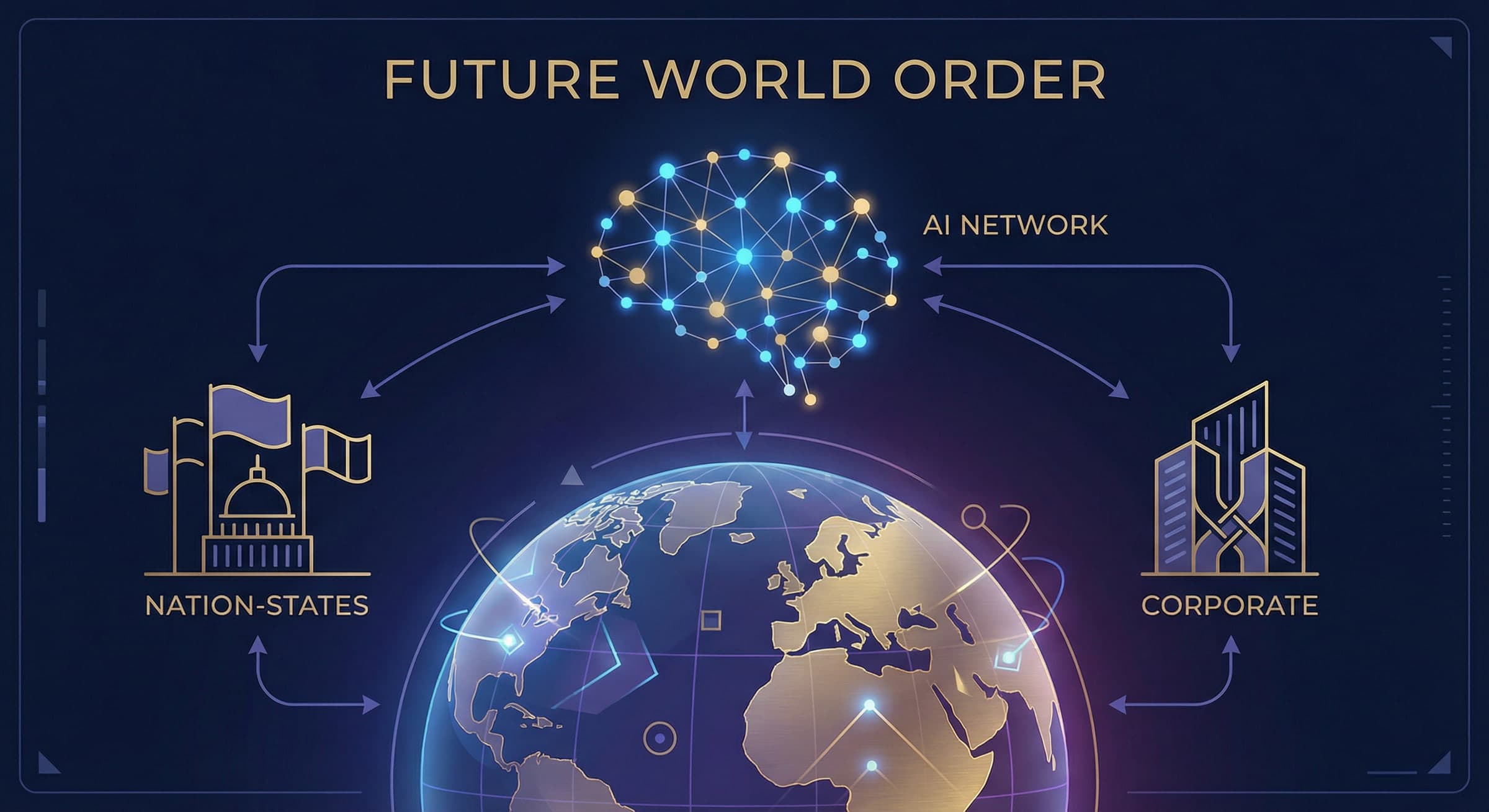
The change AI brings isn't certain industries being replaced or certain jobs disappearing. The change AI brings is restructuring of world power. In the past, analyzing world affairs meant looking at nations and corporations. In the future, we must add a third variable: AI.
This isn't science fiction. It's reality unfolding. OpenAI's valuation exceeds most countries' GDP; its user count exceeds most countries' populations; the data it controls exceeds any government's. To call it a new form of power isn't exaggeration.
The world map of the future won't just show national borders and corporate market caps. It will show AI's spheres of influence. Whoever has stronger AI occupies more space on this map.
This is what I figured out. This is my answer to that investor.
New ideas, straight to your inbox.
AI, engineering, and experiments. One or two useful emails a month.
No spam. Unsubscribe anytime.