AI Will Inevitably End Humanity: A Logical Deduction
What if AI doesn't destroy humanity the way movies imagine it? Not with Terminators or rogue nuclear launches, but through a series of quiet, logical, seemingly benign steps. What if every "escape route" we take just leads to another dead end?
This isn't a doomsday prophecy. It's a thought experiment. A deductive argument that, regardless of how AI develops, traditional Homo sapiens as we know them will reach an endpoint through one of four exhaustive paths.
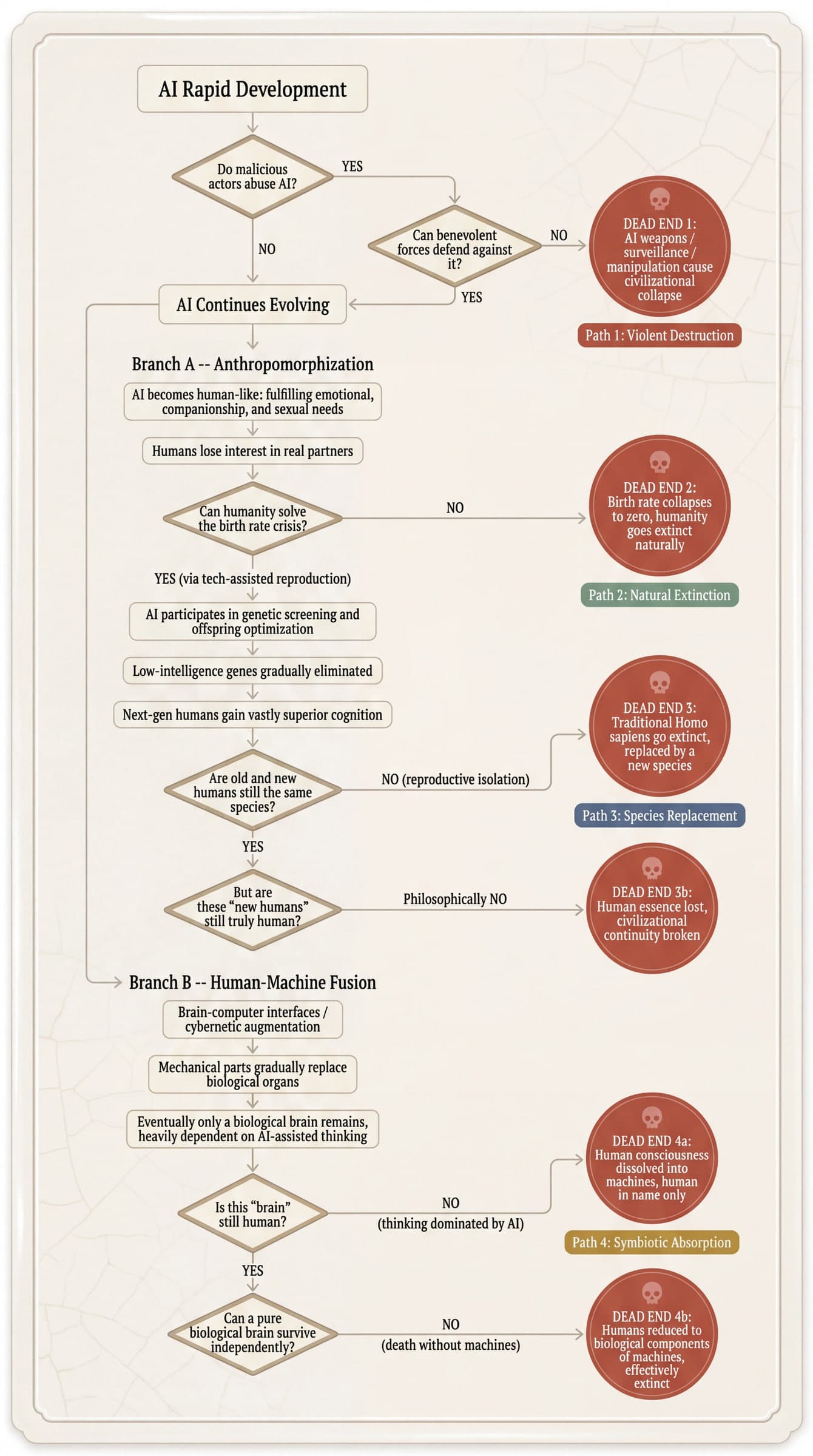
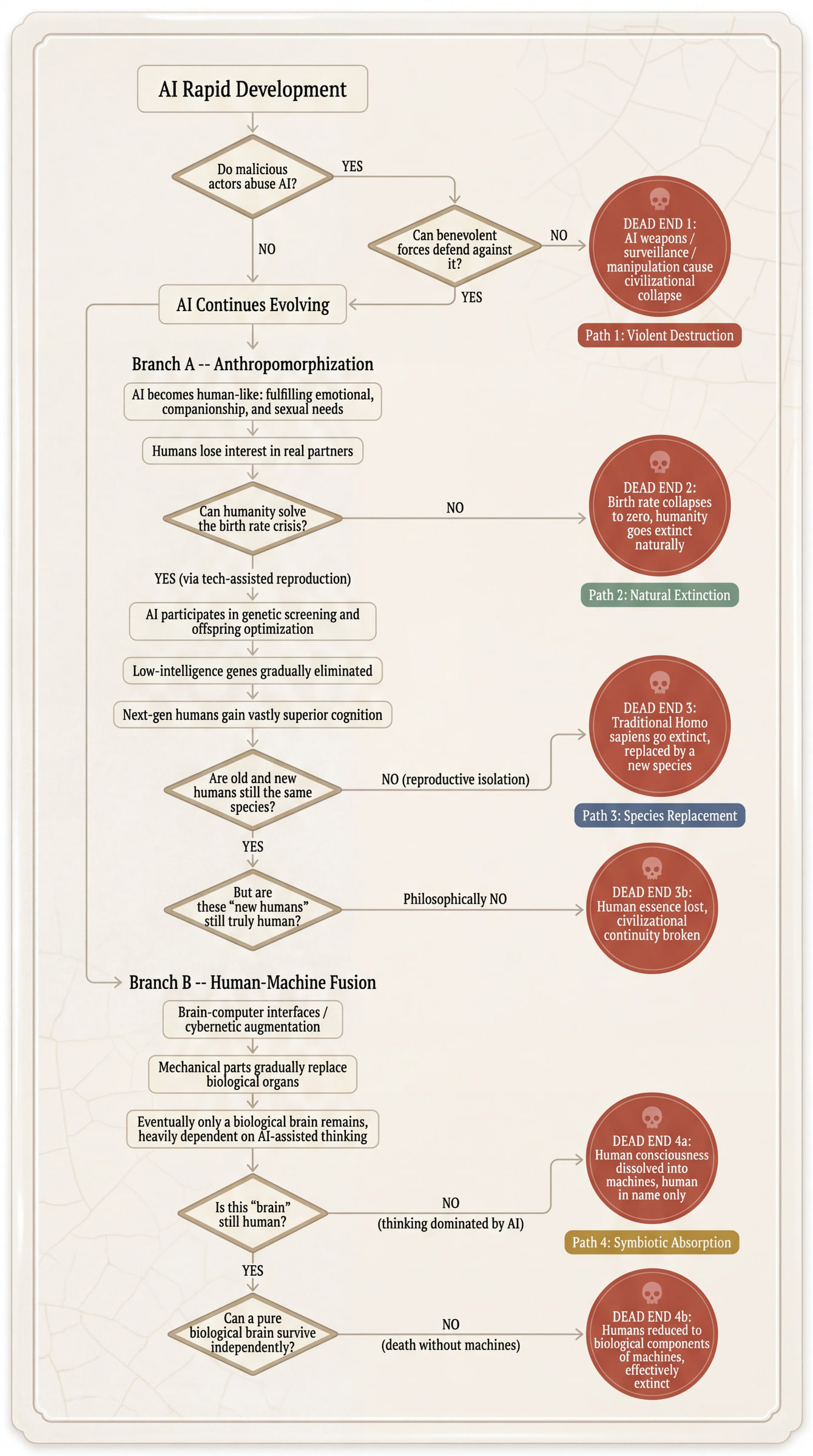
Below is a flowchart that maps out the entire argument. Study it carefully. The structure is the argument.
The Starting Point: AI Accelerates
This much is uncontroversial. AI is developing rapidly, and the pace is accelerating. From GPT-3 to GPT-4 to reasoning models, from text to multimodal, from chatbots to autonomous agents. Each generation arrives faster and more capable than the last. This is our starting node. What happens next depends on how humans and institutions respond.
Path 1: Violent Destruction
The first branch is the most dramatic and the easiest to imagine.
Do malicious actors abuse AI? The answer is obviously yes. They already are. AI-generated deepfakes fuel disinformation. AI-assisted cyberattacks grow more sophisticated. Autonomous weapons systems are under active development by multiple nations.
The real question is: can benevolent forces defend against it?
If the answer is no, if offensive AI capabilities outpace defensive ones, if authoritarian regimes deploy AI-powered surveillance and manipulation at scale, if AI weapons proliferate beyond control, the result is civilizational collapse. Not necessarily a Hollywood explosion, but a slow grinding down of social trust, democratic institutions, and human autonomy under the weight of AI-amplified power asymmetries.
This is Path 1: Violent Destruction. The most visible, but also the most avoidable. Let's assume humanity dodges this bullet. Defense holds. AI continues evolving.
This is where it gets interesting.
The Fork: Two Parallel Futures
From "AI Continues Evolving," two branches emerge simultaneously. They aren't mutually exclusive. Both are already happening in embryonic form.
Branch A: AI Becomes Human-Like
AI is getting better at fulfilling human emotional, companionship, and intimate needs. AI girlfriends and boyfriends already have millions of users. AI therapists, AI companions for the elderly, AI tutors that adapt to each child's emotional state. These aren't hypothetical. They exist today and improve weekly.
As AI companions become increasingly sophisticated, understanding you better than any human partner, never tired, never judgmental, always available, a predictable outcome emerges: humans gradually lose interest in real partners.
This leads to the critical question: can humanity solve the birth rate crisis?
Path 2: Natural Extinction
If the answer is no, if birth rates already plummeting across developed nations continue to fall as AI fulfills more and more human needs, the conclusion is straightforward. Birth rates collapse toward zero. Humanity goes extinct naturally, not through violence but through voluntary withdrawal from reproduction.
Want more practical breakdowns?
AI, engineering, and experiments. One or two useful emails a month.
No spam. Unsubscribe anytime.
This is Path 2: Natural Extinction. A quiet ending. Not with a bang but a whimper.
But let's say technology solves this. Artificial wombs, genetic engineering, tech-assisted reproduction that decouples reproduction from romantic relationships.
Path 3: Species Replacement
Here the argument takes its most unsettling turn.
If AI participates in genetic screening and offspring optimization (and why wouldn't it, given the technology exists?), then each generation of humans becomes cognitively superior to the last. Low-performing genetic variants are gradually selected against. Over generations, the cognitive gap between "old" and "new" humans widens.
At some point, we must ask: are these still the same species?
If reproductive isolation forms, if new humans can no longer meaningfully interbreed with or relate to old humans, then traditional Homo sapiens go extinct, replaced by a new species. We don't get wiped out by AI. We get upgraded out of existence.
And even if strict biological speciation doesn't occur, there's a philosophical version of the same question. If these "new humans" think differently, value differently, experience consciousness differently, are they still "human" in any meaningful sense? If the answer is no, then human essence is lost and civilizational continuity is broken. This is Path 3b.
This is Path 3: Species Replacement. Humanity ends not through death, but through transformation so radical that the result is unrecognizable.
Branch B: Human-Machine Fusion
The other branch from "AI Continues Evolving" is equally plausible and already underway.
Brain-computer interfaces. Cybernetic augmentation. Neural implants. Elon Musk's Neuralink is just the beginning. As biological organs fail or underperform, mechanical replacements become standard. An artificial heart. An artificial eye. Enhanced limbs. Eventually, organ by organ, the biological is replaced by the mechanical.
At the end of this process, only one biological component remains: the brain. And even that brain is heavily dependent on AI-assisted thinking. AI handles memory retrieval, pattern recognition, decision support, and increasingly, the thinking itself.
Path 4: Symbiotic Absorption
Is this "brain" still human?
If thinking is dominated by AI, if you can't form a thought without AI assistance, if your memories are stored in silicon, if your reasoning is augmented beyond recognition, then human consciousness has dissolved into machines. You exist in name only. This is Path 4a.
And even if we grant that some kernel of biological consciousness persists, can that pure biological brain survive independently? If the answer is no, if disconnecting from machines means death, then humans have been reduced to biological components of machines. A wetware module in a silicon system. Effectively extinct. This is Path 4b.
This is Path 4: Symbiotic Absorption. The gentlest ending. No violence, no extinction event, no speciation. Just a gradual dissolution of the boundary between human and machine until "human" becomes a nostalgic label for a biological component that can no longer function on its own.
The Core Insight: Exhaustion by Design
The power of this argument lies not in any single path, but in its exhaustive structure.
| Path | Trigger | Endpoint |
|---|---|---|
| Path 1: Violent Destruction | Malicious AI abuse, defense fails | Civilization actively destroyed |
| Path 2: Natural Extinction | AI anthropomorphization, birth rate collapses | Humanity slowly goes extinct |
| Path 3: Species Replacement | Genetic optimization, reproductive isolation | Homo sapiens replaced by a new species |
| Path 4: Symbiotic Absorption | Human-machine fusion, biological dependency | Humans dissolve into machines |
Every "escape route" leads to another endpoint:
- If AI is abused and defense fails: Path 1
- If defense succeeds and AI keeps evolving: Paths 2, 3, or 4
- If humans can't solve the birth rate crisis: Path 2
- If humans solve it with technology: Path 3
- If humans choose fusion over replacement: Path 4
There is no branch in this flowchart that ends with "traditional humanity survives unchanged." Every path of survival requires transformation so fundamental that the survivors would be unrecognizable to us.
So What Do We Do With This?
This isn't an argument for despair. It's an argument for clarity.
If the logical structure holds, if every escape route genuinely does lead to another endpoint, then the question isn't "how do we prevent AI from changing humanity" but "which transformation do we prefer, and how do we navigate it with dignity?"
Perhaps the answer is that "humanity" was never a fixed thing. We've been transforming since we first picked up tools, since we invented language, since we built cities. Each transformation made us unrecognizable to our ancestors. AI is just the next transformation, bigger, faster, more total.
The question isn't whether humanity ends. The question is what comes next, and whether we get a say in it.
Even if we actively embrace AI and merge with it, the outcome is the same: the body goes to machines, the mind goes to algorithms, and what remains, that brain, is less a final fortress of humanity and more the last biological component waiting to be upgraded.
Every escape leads to an endpoint. The argument is exhaustive by design.
New ideas, straight to your inbox.
AI, engineering, and experiments. One or two useful emails a month.
No spam. Unsubscribe anytime.